




RiWild Sanctuary and Charitable Trust has launched a statewide awareness campaign during Wildlife Week 2026 to highlight the illegal trade and keeping of native wild birds, turtles and other wildlife species as pets.
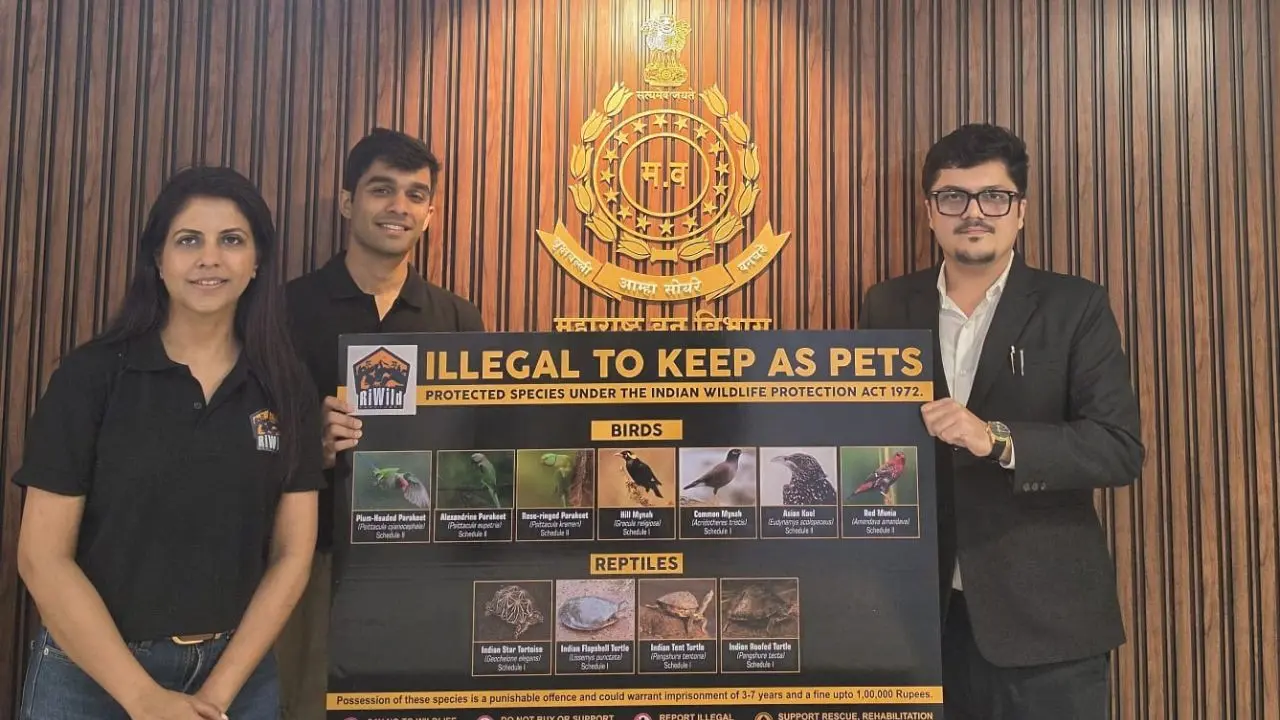
The campaign was formally launched by Maharashtra Principal Chief Conservator of Forests (PCCF) Srinivas Reddy, who unveiled a series of awareness posters featuring wildlife species commonly trafficked and illegally kept as pets in India.
Maharashtra Principal Chief Conservator of Forests (PCCF) Srinivas Reddy (centre). Pic/ RiWild Sanctuary
Posters to be distributed across 500 veterinary clinics
As part of the initiative, the posters will be distributed to more than 500 veterinary clinics across Maharashtra. The campaign aims to use veterinary clinics as points of public awareness, enabling veterinarians to educate pet owners about native wildlife species that cannot legally be kept as pets, as well as the legal provisions, penalties and other consequences associated with their illegal possession and trade.
Dr Rina Dev, president of RiWild Sanctuary and Charitable Trust, said veterinarians have an important role to play in educating pet owners, particularly those who unknowingly purchase wildlife through the illegal pet trade.
“It is important for veterinarians to raise awareness among pet owners, as many people unknowingly purchase wildlife species that are illegal to keep as pets and subsequently do not know what to do with them. Unfortunately, many of these animals are eventually abandoned,” Dev said.
She cited instances of Indian Star Tortoises being abandoned on highways and dumped in municipal garbage bins.
Campaign targets illegal wildlife trade
RiWild said growing demand for wild animals as exotic or unusual pets contributes to a cycle of illegal capture, trafficking, improper care and eventual abandonment.
Veterinarians, the organisation said, can help break this cycle by educating owners and directing them to the appropriate authorities and rehabilitation organisations when wildlife is encountered.
The campaign also seeks to address the misconception that native wildlife can legally be kept as pets simply because the animals are readily available through the illegal pet trade.
The posters provide information to help veterinarians and members of the public identify commonly trafficked species and understand the legal consequences of possessing or trading them.
“Awareness is one of the most important tools in preventing wildlife trafficking. If a person knows that an animal cannot legally be kept as a pet before purchasing it, we can prevent the animal from entering the illegal trade in the first place,” Dev said.
Wildlife possession can attract legal action
Through the campaign, RiWild Sanctuary and Charitable Trust aims to create a network of informed veterinarians and responsible pet owners to help prevent the illegal acquisition and abandonment of India’s native wildlife.
Advocate Pawan Sharma, president of RAWW, said several commonly kept wildlife species are protected under Schedule I and Schedule II of the Wild Life (Protection) Act, 1972.
“Keeping, possessing, buying, selling or trading such wildlife without lawful authorisation can attract legal consequences under the Act. It is important for the public to understand that being commonly available does not necessarily make a wild species legal to keep as a pet,” Sharma said.