




Wenden Avenue Railway Colony in Matunga was once a place where time seemed to pause. Its canopy of trees, stone buildings, and winding lanes kept it insulated from the city’s chaos for more than a century. Home to generations of railway families, the colony’s architectural charm and sense of community were its defining features. Today, the same streets are a maze of JCBs, piling rigs, and dumpers.
The old Nissen huts of Wenden Avenue. Pic/Dr Shekhar Krishnan
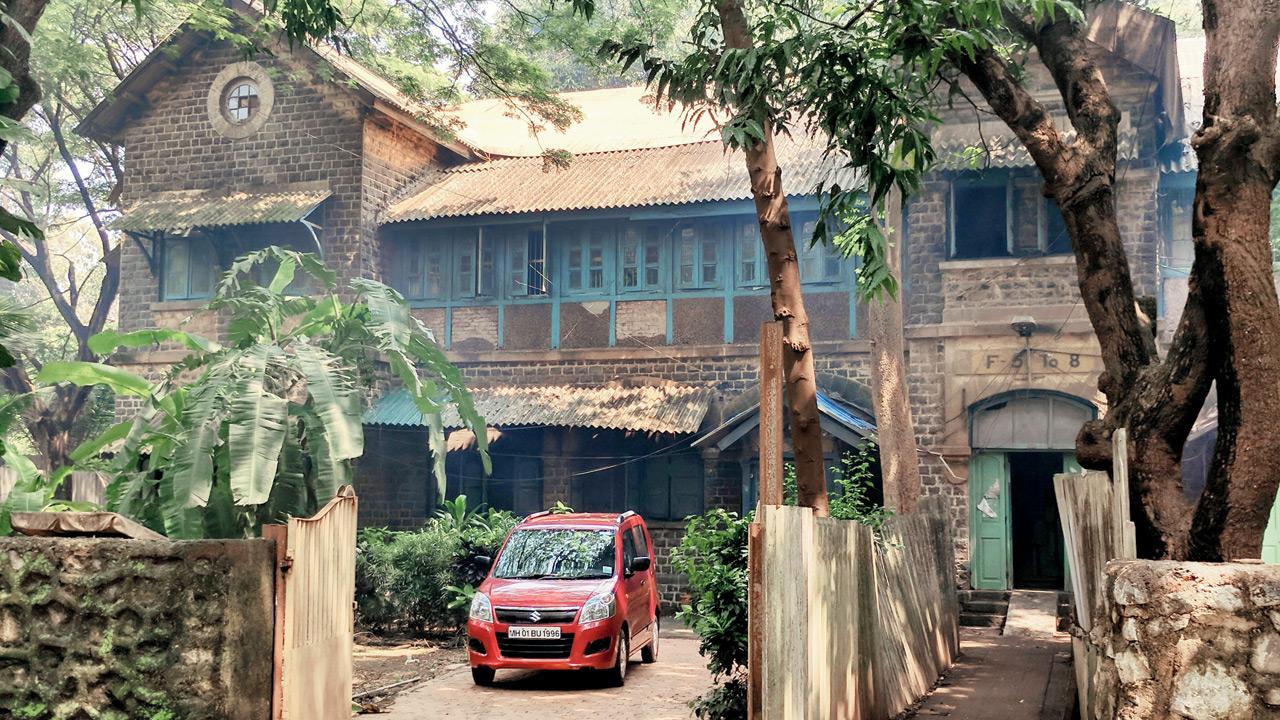
The century-old Matunga railway colony has been handed over for the Dharavi redevelopment project, and demolition of its buildings is underway. The colony housed employees of both Central and Western Railway. While the WR section had relatively newer concrete blocks, the CR side was lined with Nissen huts and beautifully crafted stone structures.
Origins of the name
A partially demolished building in the Matunga railway colony. Pic/Dr Shekhar Krishnan
Wenden Avenue was named after Henry Charles Edward Wenden, Agent of the Great Indian Peninsula Railway (now General Manager). Wenden, an accomplished railway engineer and avid ornithologist, wrote for Allan O’Hume’s journal Stray Feathers. Records show he served as GIP Railway’s Agent from 1901 and retired in 1906. Today, the last stone buildings have been flattened, and most Nissen huts have also been removed. These iconic mushroom-shaped structures once dotted the colony’s central stretch.
Historian remembers
The Wenden Avenue signboard at the entrance to the century-old road. Pic/Samson Mathew
Dr Shekhar Krishnan, historian and advisor to the BMC Heritage Conservation Cell, recalls, “My mother used to walk up and down this road to school every day from ‘BB Matunga’ to ‘GIP Matunga’ (WR and CR). In the fifties, there were no bridges between the two Matungas. The old Lady Hardinge Road ended in a level crossing, and gates across the two lines were opened and closed at fixed times, lit by gas lamps and their bearers in mornings and evenings. Wenden Avenue was built as staff quarters for the GIP Railway Workshop on the other side of Lady Hardinge Road.
Flattened section of the colony after demolition. Pic/Rajendra B Aklekar
Its iconic buildings were visible to the public who walked beneath the workshop’s massive walls on one side and their leafy stone bungalows and shady cottages opposite. GIPR’s Mahim Loop, linking Mahim to the Harbour Line by local train, was the only way across the two Matungas until decades after Independence. But soon after road and foot overbridges came up between WR and CR (BB and GIP), the level crossing was closed, and Wenden Avenue began disappearing from view behind growing greenery, roadside slums and greying stone facades. Now it’s gone forever.”
Families share memories
Samson Mathew and family at Wenden Avenue before demolition. Pic/Samson Mathew
Retired Central Railway employee Samson Mathew, who has lived there since 1975, said, “It was once one of the most tranquil places in Mumbai. A full canopy of trees, monsoon charm, and birds at dawn. The English bungalows with their 24 by 24 foot bedrooms were a wonder. These memories now exist only in the mind. Time to move on, but Wenden Avenue will always stay with us.”
Author recalls his rly days
“Wenden Avenue at Matunga also served as a probationers’ hostel,” recalls former railwayman turned author and businessman Sanjay Chandra, who says his railway journey began there. “We were impressed with the address of our hostel. Wenden Avenue sounded so fancy. We had no idea what surprise awaited us,” he said.
Broken remains of the old colony structure. Pics/Dr Shekhar Krishnan
“After completing our joining formalities, and without having met the General Manager yet, we hailed a kali peeli taxi — there was no Ola or Uber in 1982 — dumped our luggage in, and asked the driver to take us to Wenden Avenue, Matunga. Coming from small towns, driving around Bombay was an exciting experience. We reached Matunga in the evening. Nobody in the neighbourhood had even heard of Wenden Avenue. There was no GPS back then. After asking around repeatedly, we were finally directed to a not-so-impressive building tucked in a corner beyond a drain, surrounded by overgrown bushes,” he writes in his book The Life & Times of a Common Man.
One of the last surviving examples of Wenden Avenue’s old stone architecture
Speaking to mid-day, Chandra added, “The probationary officers’ hostel on the exotically named Wenden Avenue was our temporary home during our railway training in 1982. We returned to the city every two months for the next phase. The building was small and couldn’t accommodate all 48 of us comfortably. Many nights, we slept on the floor. But it was a minor inconvenience compared to the friendships we built and the lessons we learned walking to the nearby market and railway station.”
All is lost
“All is lost. It was a place of peace. We lived under the shade of old trees and timeless architecture when we returned from work. Sundays and holidays were days of community bonding. In recent years, its use had declined, but we still visited for nostalgia and childhood memories. Instead of demolishing such century-old heritage, the developers could have used it creatively, incorporating those classy bungalows,” said a long-time Central Railway employee.
When buildings fall, memories rise: The soul of Wenden Avenue
Venu P Nair, General Secretary, National Railway Mazdoor Union (CR & KR), says, Wenden Avenue was never just a cluster of railway quarters. It was a living institution built on solidarity, shared struggle, and deep community ties. Within its graceful stone buildings, thousands of railway families lived in quiet fraternity. Late-night conversations between workers, staff, and NRMU activists often shaped the union’s most principled stands and resistance movements.
Venu P Nair
The colony thrived as a socio-cultural hub. Sports, cultural events, and union meetings merged into everyday life, while children grew up running through tree-lined avenues under the shade of banyan, jamun and mango trees. Even today, though they are scattered across the world, their memories of Wenden remain intact.
Each home carried its own warmth — gardens, kitchens filled with familiar aromas, and the old consumers’ store where children learned trust and responsibility. Presiding over it all was the iconic Wenden Avenue Hall, always alive with activity.
As these structures are razed, what pains residents and railwaymen is not just the loss of buildings, but the erasure of a way of life. Wenden Avenue will endure in memory as a rare township where heritage, dignity and social harmony once flourished together.