

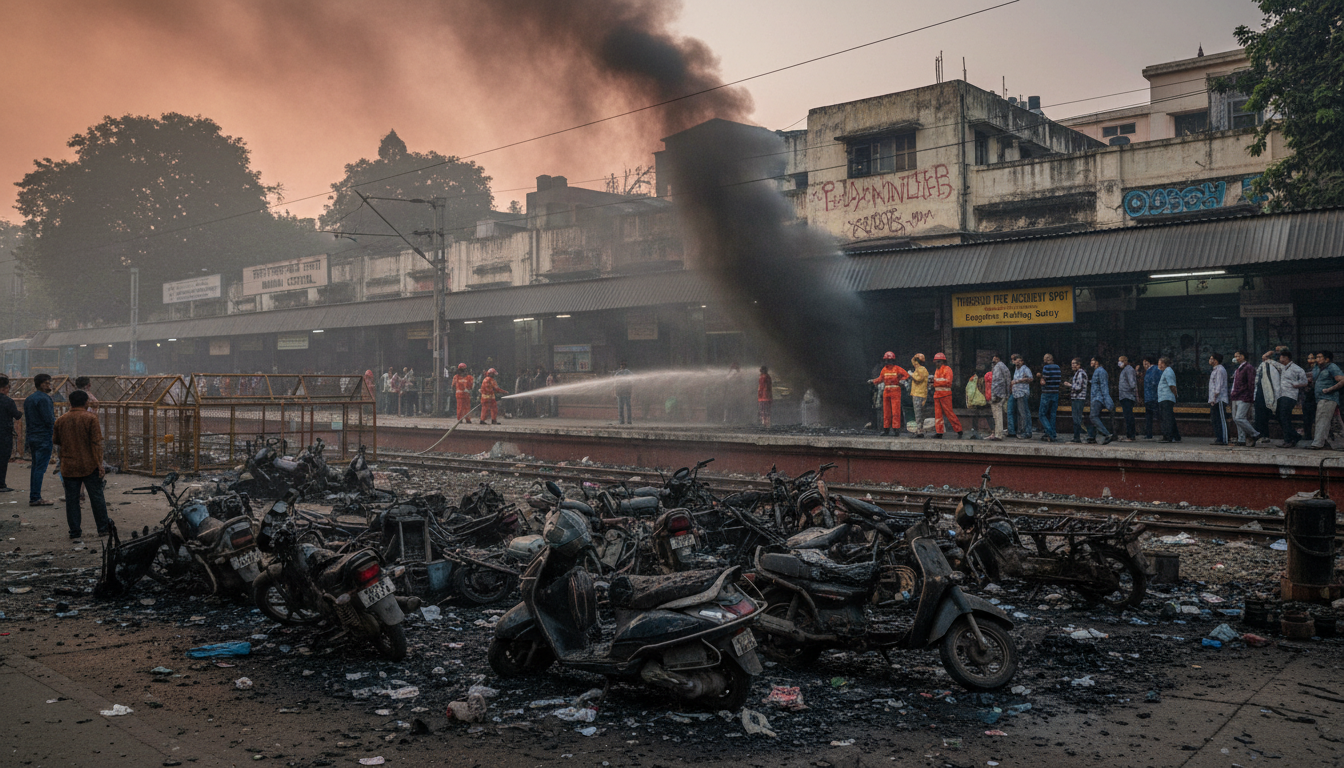
The recent devastating fire at the Thrissur railway station in Kerala, which reduced several parked vehicles to ashes, has sent shockwaves through the administrative corridors of India’s transport sector. While the incident occurred in the south, the alarm bells are ringing loudest in Mumbai. According to an analysis by Lokmaha News, this incident has highlighted the critical need for enhanced railway station parking safety in India’s financial capital, where infrastructure is perpetually stretched to its limits.
The Domino Effect: Why Mumbai is Vulnerable
Mumbai’s suburban railway network is the lifeline of the city, causing its parking facilities to be among the most congested in the world. Major hubs like the Chhatrapati Shivaji Maharaj Terminus (CSMT), Dadar, and Thane see thousands of vehicles parked in close proximity daily. The Thrissur incident serves as a grim case study of the "domino effect," where a fire starting in one vehicle can instantly engulf an entire lot due to a lack of spacing.
Lokmaha News observes that many parking lots adjacent to railway tracks in Mumbai lack dedicated fire safety mechanisms. In many cases, two-wheelers are packed so tightly that retrieving a vehicle—let alone navigating a fire hose during an emergency—is nearly impossible.
Calls for Immediate Safety Audits
Following the Kerala blaze, safety experts and daily commuters are urging the Central and Western Railways to conduct immediate fire safety audits. Currently, many pay-and-park schemes are outsourced to private contractors, and questions are being raised regarding their adherence to safety protocols.
Key concerns identified by Lokmaha News include:
- Lack of Fire Hydrants: Most parking zones lack high-pressure hydrants capable of tackling fuel-based fires.
- Outdated Extinguishers: Reliance on basic, often expired, handheld extinguishers rather than automated sprinkler systems.
- No Evacuation Plans: The absence of clear exit routes for vehicles in the event of a disaster.
Key Safety Recommendations
To prevent a repeat of the Thrissur disaster in Mumbai, urban planners suggest a three-pronged approach. First, authorities must enforce mandatory spacing between vehicles to create firebreaks. Second, the installation of advanced fire detection systems in covered parking areas is non-negotiable. Finally, strict penalties must be imposed on contractors who violate capacity limits to maximize profit.
As the city continues to grow, railway station parking safety can no longer remain an afterthought. The administration must act proactively to protect both public property and the lives of millions of commuters.