
The BEST Museum at Anik has acquired a rare and crucial piece of Mumbai’s transport history: one of the oldest surviving handwritten records from the city’s horse tram era, dating back to around 1887, just 14 years after the company was founded. The find includes bound volumes titled Organisation Book – Bombay Tramway Company Ltd, along with another century-old book from around 1919 containing handwritten notes by Robert Bell Cartwright, one of the most influential British tramway engineers of the early 20th century.
Yatin Pimpale, museum curator
Cartwright played a key role in the expansion of London United Tramways and Metropolitan Electric Tramways, overseeing the transition to electric tram systems across west and north London. His detailed notes, now part of BEST’s collection, document tram operations, management practices and record-keeping methods that later became the template for the functioning of the Bombay Electric Supply and Tramways undertaking.
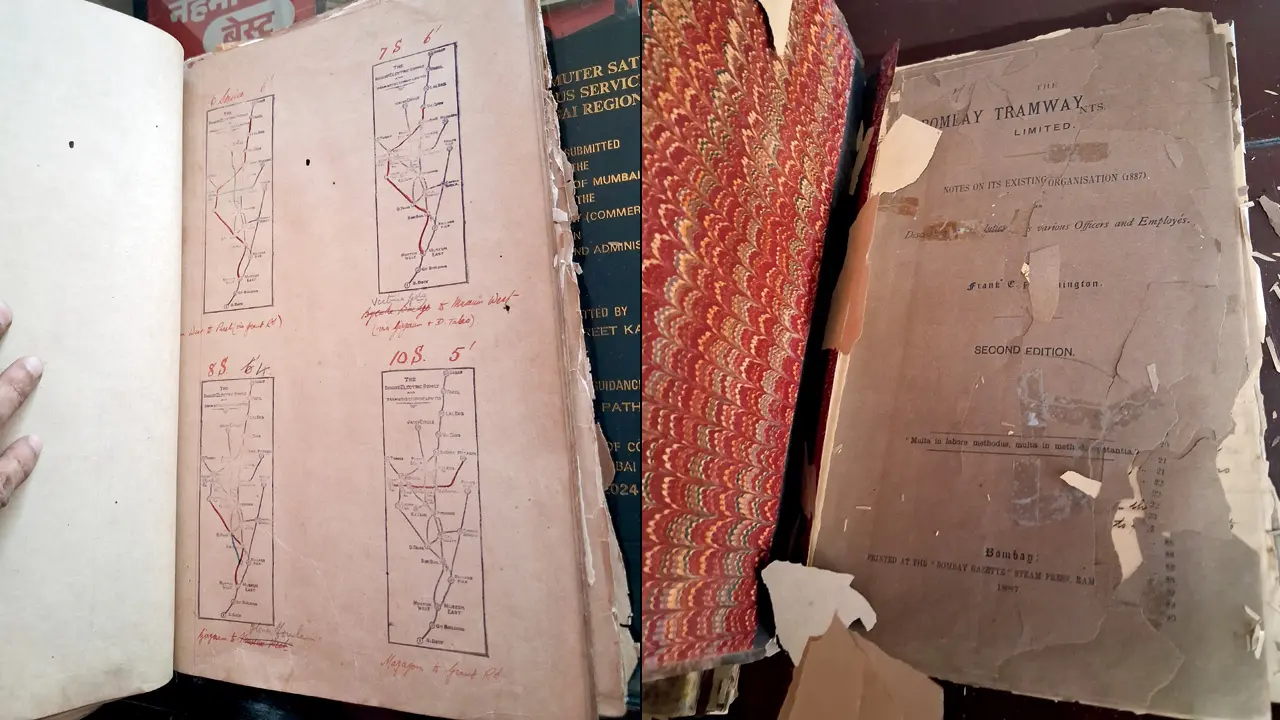
The bound ‘Organisation Book – Bombay Tramway Company Ltd’ found at BEST’s Wadala depot
The 138-year-old volumes were discovered during routine cleaning at the traffic administration office inside the Wadala depot, the nerve centre of BEST’s bus operations. The books had been lying untouched for decades before being identified and handed over to the BEST Museum. A look inside the fragile volumes reveals meticulously handwritten route charts, transport receipts, financial records and operational notes, some of them partially printed. Over time, the paper has turned yellow and brittle and now disintegrates on touch, prompting the need for urgent restoration.
A handwritten reference to British tramway engineer Robert Bell Cartwright in a 1919 volume
“This is a goldmine. These documents give us rare insights into how Bombay’s horse tram system functioned, from routes and maps to daily operations before electric trams were introduced,” said museum curator Yatin Pimpale. “Given their condition, the volumes will soon be handed over to the Chhatrapati Shivaji Maharaj Vastu Sangrahalaya for professional restoration.”
Hand-drawn route markings inside the century-old Bombay Tramway Company ledger. Pics/Rajendra B Aklekar
BEST began in 1873 as the Bombay Tramway Company Limited, operating horse-drawn trams from 1874. Electric trams were introduced in 1907, and the organisation was later renamed the Bombay Electric Supply and Tramways Company, before becoming the Brihanmumbai Electric Supply and Transport undertaking in 1995.
Worn out pages from the 1887-era horse tram records, now preserved by the BEST Museum
Experts say the discovery adds a vital chapter to the city’s public transport story. “These are foundational documents of Mumbai’s road-based public transport system,” said Kunal Tripathi, who runs the Mumbai Heritage social media account. “They show how early transport systems were planned, managed and sustained in a growing city.”
“At a time when BEST’s reputation is being questioned by sceptics, it is crucial to underline its monumental role in Mumbai’s civic infrastructure by preserving, studying, and carrying forward its history. The journey from horse trams to electric trams, then to buses and now electric buses, is a legacy that must be continuously taught to both present and future generations,” said Ramchandran Venkatesh, city history expert.
History of Bombay’s horse trams
How Mumbai’s first public transport ran
Beginning
Bombay’s first horse-drawn tram service began on May 9, 1874, operated by the Bombay Tramway Company Limited.
Routes
The earliest routes ran:
>> Colaba to Pydhonie (via Crawford Market)
>> Bori Bunder (now CSMT area) to Pydhonie
Horses and cars
Operations began with 200 horses, of which 100 horses and 20 omnibuses were purchased from the Bombay Omnibus Company for R30,000.
Horses were of two types:
>> Gulf Arabs for double-horse cars (Rs 400 each)
>> Walers for single-horse cars (Rs 600 each)
Tramcars included closed double-horse cars, open double-horse cars and open single-horse cars. Larger trams sometimes required six to eight horses. The horses were stabled in what is now Ness Baug.
Fare and speed
Fares ranged from one to three annas, with trams travelling at about 5 miles per hour.
End of the horse tram era
Horse-drawn trams were phased out with the arrival of electric trams.
>> Last horse tram ran: August 1, 1905
>> Electric trams shut down: March 31, 1964